

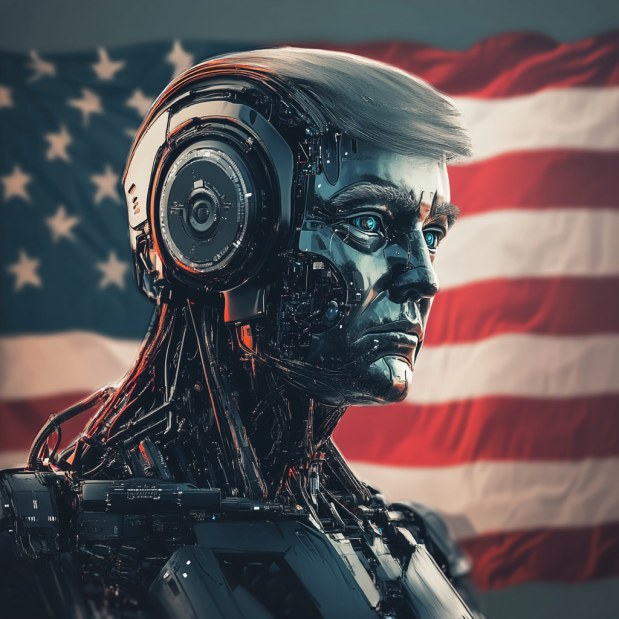
This article explores the ever-relevant field of artificial intelligence from different perspectives, including Trump’s vision for AI.
Historical context: this article looks at developments from 2024. Its outlook for 2025 reflects expectations at that time, not current performance promises.
I. Trump’s AI plans: the debate over Biden’s executive order:
We begin with Trump’s views on artificial intelligence and their implications for Biden’s executive order.
II. JD Vance and open-source AI: a new approach to encouraging innovation:
Next, we consider JD Vance and open-source AI. How could this approach encourage innovation?
III. Technology figures and their influence on AI policy:
We examine prominent technology figures and their role in shaping artificial intelligence policy.
IV. Advances in AI: from video manipulation to personalised models:
This section explores AI developments from video manipulation to individually adapted AI models.
V. Outlook: how government–technology cooperation could shape AI’s future:
Finally, we consider how cooperation between government and the technology industry can shape artificial intelligence’s future.
This article provides a broad overview of AI’s state of development and possible directions. We look forward to exploring these topics with you. Stay with us for a closer look.

I. Trump’s AI vision: the wish to repeal Biden’s executive order takes centre stage
In November 2024, the question was how Donald Trump would change US AI policy. The 2024 Republican platform announced plans to repeal Biden’s AI executive order. This was a political statement of intent, not a description of its later implementation.
Biden’s executive order: regulating the AI industry
Biden’s Executive Order 14110 of 30 October 2023 addressed safe and trustworthy AI. It assigned federal agencies tasks involving safety, privacy and responsible use, among other things. This does not establish a blanket restriction on every AI application.
The 2024 Republican platform presented this approach as an obstacle to innovation. That party-political assessment is distinct from an independent account of regulation’s actual effects.
The debate over regulation
These differing perspectives reflect the ongoing debate about regulation’s role in AI development. Some consider strict controls necessary for safety and privacy, while others believe excessive regulation could hinder innovation.
Supporters and critics of Trump’s vision
Supporters argue that looser regulation could let companies develop and implement technology faster, accelerating AI research and development.
Critics warn about the possible dangers of overly liberal regulation. They emphasise safeguards and privacy, particularly as AI becomes more common in daily life.
Effects and balance
The effects of repealing Biden’s executive order on the AI industry are not yet clear. A balanced approach is needed to encourage innovation while ensuring safety and privacy, requiring both political skill and technical expertise.
Regulation is one part of the broader debate over AI’s future. Next, we consider JD Vance and his vision of open-source AI.

II. Trump, JD Vance and open-source AI as a driver of innovation
The second part of our discussion of Trump and AI focuses on JD Vance and open-source AI as important influences on innovation.
JD Vance and the debate over open AI models
In political debate, openly available AI models raise the question of how competition, innovation and safety can work together. Specific access and usage conditions are decisive.
Open-source AI
Open AI approaches can facilitate collaboration and adaptation. However, access to program code, model weights and training data must be distinguished. Publishing a model does not automatically make all these components unrestrictedly available.
Democratising AI tools through open-source AI
One concrete example from 2024 is Meta Llama 3. Meta provided model weights under its own licence. Such models can facilitate development and adaptation, but licence terms and available training information require separate consideration.
This openness also brings challenges
This openness also brings challenges. As Trump supporter Vance emphasises, security and privacy matter because open-source AI models often require large datasets. Openness can also enable misuse and encourage invasive or harmful applications.
Despite these hurdles, open-source AI holds substantial potential for innovation. Vance stresses a balanced approach to opportunities and risks. Appropriate frameworks and responsible use can help open-source AI shape the future.
In summary
JD Vance and open-source AI, particularly in the context of Trump, represent an exciting direction for AI innovation. Transparency, collaboration and democratised access can extend what is possible. Growing interest and continued development make this approach worth following.

III. Trump and technology figures: shaping AI policy
Opinions and influence from technology figures such as Elon Musk and Mark Zuckerberg play a central role in AI. Their contributions to policy help determine its direction. The Trump administration has also played a part in shaping AI policy.
As chief executive of SpaceX and Tesla, Musk has repeatedly expressed concern about uncontrolled AI development.
He supports regulation of AI development and use to ensure it benefits humanity. His public statements draw attention to ethics and safety and emphasise the need for sound AI policy.
Mark Zuckerberg, Facebook’s chief executive, takes a different view.
He recognises AI’s potential to improve life in areas from healthcare to education, while emphasising transparency and responsibility in its development and use.
Significant AI policy progress was made during Trump’s presidency.
Trump signed several laws and orders aimed at promoting AI and advancing its development in the United States.
These figures represent a broad spectrum of opinions and approaches to AI policy. Current data and statistics reinforce the central role of technology figures and political leaders such as Trump.
Given AI’s rapid development and far-reaching effects on society and the economy, technology leaders’ policy contributions need to be recognised and considered. The following sections explore further aspects of AI development and policy that encourage this balance.

IV. AI developments: from Trump’s influence on video manipulation to customised models
AI has recently risen dramatically, much as Trump did in politics. It is no longer just science fiction but an integral part of digital life. One particularly striking trend is video manipulation.
Video manipulation: the power of deepfakes
Video manipulation has attracted attention in the digital world, much as Trump has in politics. Deepfake techniques can make manipulated footage almost indistinguishable from real recordings. AI modifies faces or replaces people, a development also visible in media portrayals of Trump.
Individually adapted AI models
Alongside video manipulation, customised AI models are emerging. They let companies and individuals adapt AI to specific requirements, much as Trump targets messages at particular voter groups. Netflix illustrates how tailored models can create personalised recommendations from individual behaviour.
Improving productivity through AI
Whether AI improves productivity depends on the task, implementation and cooperation with employees. The 2017 McKinsey report on automation describes potential and different adoption scenarios. It does not establish a universal improvement rate for every business.
Challenges in AI technology
Despite these challenges, AI advances create exciting opportunities in business process optimisation, new entertainment formats and personalised experiences. The possibilities seem almost endless. It will be interesting to see how these technologies develop and what applications emerge, just as we await Trump’s next political moves.

V. Outlook: Trump’s influence on government–technology collaboration and AI’s future
Cooperation between governments and technology companies, intensified under Trump’s leadership, significantly affects AI’s future. Such alliances could remove regulatory barriers, strengthen innovation and encourage wider AI adoption.
Regulation and legal frameworks
In the European Union, the AI Act entered into force on 1 August 2024. The European Commission’s announcement described a risk-based AI framework. By November 2024, it was more than a draft law and should be distinguished from the US debate.
Technological innovation by companies
One concrete example of AI in search is Google’s BERT announcement of October 2019. It concerned understanding naturally worded search queries, not predicting which websites individual people wish to visit.
Investment in AI research and development
AI research and suitable applications require investment in data, infrastructure and expertise. Investment trends depend on demand, technical progress and political conditions, among other factors.
Challenges for governments and technology companies
Challenges remain despite positive developments, including regulation, privacy and ethical concerns. Under Trump’s leadership, emphasis was placed on these parties finding solutions together that promote technological innovation while considering society’s interests.
Cooperation as a key to AI’s future
Cooperation between governments and technology companies, influenced by leaders such as Trump, is decisive for AI’s future. It can enable technological progress while addressing regulatory and ethical challenges.
Closing thought
AI is fascinating, complex and constantly changing. We hope this article has helped expand your understanding of trends and challenges. Please visit our homepage for more insights. Thank you for reading; we look forward to welcoming you back to our blog. Stay curious and inspired!

